Tuesday, 28 February 2012

Celtic Roots Craic! 48 – 'Up the Lagan in a bubble?'

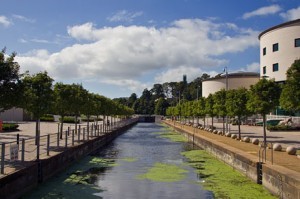
Lagan Canal and Island Arts Centre, Lisburn, Co. Antrim

26 February, 2012

On the last show I was describing how, many years ago, my father had sowed grass seed with a device called an 'Aero' fiddle. Just the other night I was with some friends in a small pub called 'Paddy's Barn', in Saul, Co. Down – and there, hanging up from the ceiling rafters was a perfect example of one of these devices – which I haven't seen in over 50 years. It's a small world, eh?

That got me to thinking of another event from way back, which my father had told me about. I'll tell you about it in a minute. First a wee bit a' background. I was brought up in Co. Down, as I've said before, but I went to school in Lisburn, which is mainly in Co. Antrim.

The two counties are separated by the River Lagan, which flows from Slieve Croob – a hill in Co. Down near Ballynahinch – firstly west through Dromore, then north east to Lisburn and through Belfast, into Belfast lough – dividing East Belfast off from the rest of the city. There is a beautiful Irish song, 'My Lagan Love' – the air made famous by Horslips as 'Fantasia' – and the ballad itself has been covered by The Corrs, Celtic Women, Phil Coulter and a whole lot of others.

The south eastern part of the city of Lisburn is across the Union Bridge over the Lagan and is usually referred to by locals as 'over in the County Down'.  Just downstream from the bridge is what's known as The Island – a bend in the river below a weir, which was cut off by a section of canal and a lock.  This was once completely occupied by the old Island Spinning Mill, which eventually became derelict. It's now the site of the new Island Arts Centre – a venue for concerts, art exhibitions and all sorts of events.

The Lagan Navigation, as it was called, was begun in 1756, to connect Belfast Lough with Lough Neagh, the large inland lake which borders five of the six northern counties. When my father was an apprentice in what was later Barbour Threads – formerly The Linen Thread Company – he can remember the horse-drawn canal barges, known as lighters, delivering coal from the docks in Belfast to power the machinery in the Mill. The lighters also carried sand and bricks from Lough Neagh back down to Belfast.

The canal has been in disuse since 1958, with the M1 Motorway being built along eight miles of the canal basin in the mid 1960s. The tidal section of the Lagan through the city of Belfast became navigable again in 1994, when the new Lagan Weir was completed. This keeps the water level upstream at a fairly constant level by raising and lowering five gates which can also protect from floods during extremely high tides.

You can enter the enclosed basin for an hour or two either side of high tide, so we have taken our boat, 'Warrior Maid', up through Belfast Harbour and into the basin – mooring it overnight at Donegal Quay, right next to the city centre, and also upstream at Stranmillis – at 'Cutter's Wharf' pub – which is as far as you can go upriver at the moment. There are plans, though, to re-open the whole navigation in the near future.

We've taken three trips in all from Groomsport, where our boat is moored, round to Belfast, also staying at the new concrete pontoon in a basin behind the Odyssey Complex and taking friends and family for short trips around the Harbour and up and down the river. On one of these trips the personnel on the Weir had forgotten to inform me when we went through the night before that the outgoing Gate 4 was not going to be in use next day, and so we ended up bumping our keel on the top of the partially closed gate! Needless to say, the weir staff weren't very pleased about this.

In 2001, when the Island Arts Centre was opened in Lisburn, that section of the canal was also restored, and the local branch of the Inland Waterways Association were invited to bring small boats along to celebrate the opening. We also own a 14 ft. wooden dinghy, so I borrowed a boat trailer and arrived on opening day with my 79-year-old dad, my three-year-old grandson, my wife, Gerry, and another young friend. We launched the dinghy from a slipway, collected the rest of our crew at the canal basin and, after negotiating the lock and accepting the loan of a small outboard motor, headed downstream for a mile to the next weir and lock, which was still closed.

On the way I happened to remark to my Dad that I bet he'd never been down the middle of the Lagan before. He agreed that he'd never done it in a boat. When I asked what he meant he replied that he HAD travelled down the centre of the river before, but on a pushbike! We were a bit puzzled until he explained that one winter when he was young, the river had frozen over completely and he and friends had cycled along the centre of the frozen river.

It was as we were happily discussing this interesting anecdote, that my little grandson mentioned that his feet were getting wet. We all looked down and sure enough the water was nearly over his shoes. On further investigation I discovered that the bung was missing at the stern of the boat and water was flowing in like a tap turned on full! We were in danger of sinking! My young friend started bailing out the water and we headed upstream as fast as our 2 HP outboard could take us – yelling ahead to our friends as we approached the lock, to keep the gate open for us. As my friend kept on bailing, and we rose slowly in the lock, we managed to get my father, wife and grandson up the ladder to solid ground.

As soon as the lock gates opened my young friend and I headed across to the slipway, still bailing out as we went. That concluded our trip on the Lagan – though we did have a nice meal in the new centre afterwards. We have an expression here in case anyone thinks we might be stupid, or gullible – 'Do you think I came up the Lagan in a bubble?'

Friday, 10 February 2012

Celtic Roots Craic! 47 – Sowin' wi' a fiddle!

The 'Aero' fiddle seed dispenser
February 10, 2012

Last week I talked about drivin', our latest Belfast sculpture and about the things we used to do when we were kids.  I mentioned how flax used to be grown a lot and how it was retted in a Flax Hole.  I never actually witnessed that process because, although my Dad used to work for what was then called, The Linen Thread Company, by the time I was around man-made fibres had taken over and very little linen was being made.

I DO remember when the neighbour's field behind our house was used to grow corn.  Now corn, means different things in different parts of the world.  In the USA it normally means maize, which we used to call 'Indian corn,' here in Ireland – it was first introduced here when America first sent us some as famine relief in the nineteenth century.  In England corn means wheat, but in Ireland corn always referred to oats – the cereal that looks most like grass, in my opinion.  We don't grow much oats any more, because it mainly used to be grown to feed horses – in the days when horses where used for agriculture.

Then tractors began to appear on the scene and horses became a thing of the past.  The first tractors we saw were mostly old Ferguson 35s, before it became Massey Ferguson.  These started on petrol and then ran on something called TVO – Tractor Vehicle Oil.  Diesel tractors came a little bit later.  In fact, out in the country we improvised our own tractthers, usually by chopping the body off an old car and adding a sort of trailer body – more like an early pickup truck than anything – but you could use one to go around a field, spreading manure, or picking up hay at haytime.  Yep, it was right out of the Beverley Hillbillies!

I drove one of these – belonging to my uncle Wullie, who lived just up the road – when I was only about six, or so.  When I say 'drove', I just steered it in a straight line, while it crawled along in first gear, while my father and cousin forked peat litter (from the hens we kept), off the back of it.  When we got near the hedge my Dad would jump down and steer it back towards the other end of the field, then go back to work.

When our neighbour's corn (oats, I mean) was ripe in the field behind us, they brought in an old Ferguson 35 tractor, towing what we in Co. Down called a 'r'aper' – in other words a former horse-drawn reaper, trailed behind the tractor – to cut the corn.  The sheaves were then bound by hand and stooked together to dry – the whole family taking part.  After a few days drying the big event took place – the thresher arrived!  This was an old – originally horse-drawn – thresher, made mostly of wood painted with orange lead paint, that had faded to a sort of pink colour.  It was trailed into the field behind a tractor and then belt driven from the tractor to thresh the corn.  No such thing as a combine harvester in those days!

Back then, practically everything was done by hand.  When our hay was ready to cut in June a neighbour would come and cut it with a r'aper, then, in the evening, the whole family would rake the hay into rows, with huge wooden handrakes.  Even with my mother and uncles and cousins helping it took hours to row eight acres – and the next day they'd have to be spread out in the sun again!  We didn't have such a thing as a baler, either, so when the hay was ready it was loaded by hand with a pitchfork onto a trailer, or one of those pick-ups, and hauled in to the yard, where it would be pitchforked again into the shed.

Our neighbour on the other side had about twenty acres, which he farmed full-time.  He would stack his hay in fairly small stacks and then later collect it with a buckrake, a large pronged implement on the back of the tractor, which reversed under the stack and lifted it up.  What usually happened, though, was that the front of the small tractor would lift up instead – so my neighbour's sons and daughter would have to sit on the front of the tractor – just like Ellie-May Clampett! – to balance the load, and they would proceed across the field see-sawing up and down – great entertainment for my brother and I.

We had one very steep field, with maybe a 40 degree slope!  It's known as the Dam Bank, because it's opposite the river, which used to have a dam back then, so that it could feed water to power a couple of watermills.  My father decided to re-sow this field one year and a neighbour ploughed it for us one-way – in other words, down the slope.  There was some room to line up at the top – though it must have seemed like jumping off a cliff – but very little room to turn at the bottom – a very hair-raising and dangerous enterprise, which nobody would dream of attempting nowadays. 

After it was ploughed and harrowed my father sowed the field – again by hand, using a piece of equipment which was common enough in those days.  It was called a fiddle, because you held it in you left hand like a fiddle, with a small a mount of seed in a bag attached over your shoulder, and you played back and forwards with a bow in your right hand, whose string went around a cogged wheel.  This wheel flung the seed out in each direction as you played and all the sower had to do was walk back and forth across the length of the field, re-filling the bag and sowing as he went.  I helped by bringing him by marking the soil already sown and bringing fresh seed – but by the time we had that field sown my Dad and I were both pretty well sunburned!

Thursday, 19 January 2012

Celtic Roots Craic! 46 – 'Awkward as a pig in a sheugh!'

'Rise' sculpture, Belfast, at night – better known locally as 'The Balls on the Falls'

I don't know if any of you, like me, are prone to criticise other drivers when you're driving a car?  I'm sure you would never do that!

My wife was beginning to get tired of me remarking on drivers with only one headlight working and suggested – a bit sarcastically, I think! – that I ought to count them and keep a record.  Great idea, I thought and immediately began counting cars with defective right and left-hand headlights. 

This had the result of my complaints being reduced to a simple, "Thirty three and thirty five, now!" every now and then, with a dry, "Yes", in response.  Eventually, I counted up over 4,000 defective headlights before I stopped, and discovered that the number of right-hand and left-hand defective lights always came back into balance.  Maybe I should publish this important research?  I don't know!

At least once a week I tend to be driving into Belfast from the Lisburn direction, in other words down the M1 Motorway.  A couple of years ago we had a major overhaul of this road, so it's now what North Americans would call a 6-lane.  It now connects directly to the Westlink, which takes you right through the middle of the city and, at the other end, connects with the M2 and M3 (Lagan Bridge).

As you come into Belfast from a southerly direction the road now dives under the Broadway Roundabout, which has recently had a huge new sculpture added.  This is in the form of two spheres, one inside the other, made up of interlocking triangles.  Locals in Belfast apparently now refer to it as the 'Balls on the Falls!'   Actually, just after they first opened the new road – and before the specially ordered pumps arrived – this tunnel flooded in heavy rain and the road had to be closed again for a while!  It happened so fast that a taxi driver who ran into the flood and stalled had to literally swim for his life!

Working in a Flax Hole
Another thing I was thinking about recently was some of the escapades we used to get up to as kids.  Just up the road from where I grew up in the Co. Down countryside, there's an estate of many acres – or a demesne, as it's often called – with a huge house and a stone wall built right around the grounds.  Incidentally, this was a 'famine wall', built in 1845/46 to provide work for poor starving labourers, in order to avoid actually giving them relief!

The father of a couple of friends of ours was the Farm Manager of this estate and they lived on the premises, so my brother and I'd often cycle up there and mess around with them.  You know, play 'King of the Castle' – by throwing each other off the top of the hay bales in the hayshade; take sips of the sweet molasses used for making silage, and leap around in the clump of rhododendron bushes right in front of the big house, as if we were monkeys!

One thing we loved to do was ride our bikes downhill as fast we could and crash into a large clump of bamboo at the bottom.  It would take us maybe ten minutes trying to extricate our bikes from the bamboo and then we'd have another go.  Right next to the bamboo was a small wood known as the 'Round Wood', which was well fenced off with 'Danger' signs placed around it.  Apparently, when the estate was previously owned by an army colonel, they placed a whole lot of unexploded World War II bombs there.  Needless to say, we never ventured in there.

Another thing we'd get up to was building dams – either across the small stream at my cousin's farm or, when we were younger, in the sheugh at the bottom of the field next to our house.  A sheugh is a field drain and, as this one led from a small bog to the river nearby, it always had water in it. We'd arrive home for tea with our clothes black and stinking with river mud.  Animals sometimes got into the sheugh to drink and then found they couldn't get out again – hence the expression, 'Ye're as awkward as a pig in a sheugh!'  At the other end of this particular sheugh – just beyond our property and right beside the bog – was what is known here as a 'flax hole'.

When the linen industry was at its height in Northern Ireland, there were thousands of flax holes all over the countryside.  Farmers would cut the flax and bind it into sheaves, which were then placed in the flax hole underwater and left to steep for weeks.  The soft outer fibres would rot away, leaving behind the strong fibres needed for making linen – a process known as 'retting'  the flax. And that's where your expensive Irish linen comes from!


Tuesday, 29 November 2011

45 – 'Ach, would yez catch yerselves on?'

Sunset over Strangford Lough, Islandhill, near Comber, Co. Down
November 14, 2011

The clocks have changed and it's getting dark quite early these days – "There's a qu'er change in the evenin's."  But strangely enough, despite all the dire predictions from the weathermen of prolonged sub-zero weather, we've actually been experiencing warmer temperatures than we had during our so-called, summer, earlier this year!  We haven't really had a proper frost yet!  It just goes to show ye what it shows ye – ye can never predict the weather in Ireland.  It's always got a wee surprise in store for ye.

Mind you, mild as it's been, we've certainly been havin' more than our fair share of rain –  'Mingin' is a good Belfast description of it (that means it stinks).  Or you could say, 'It's bin putrid!'  'It's bin comin' down in bucketfuls' – or, 'bucketin wi' rain.'  Or, "It's teemin' down out there."

I was gettin' some work done to my car the other day and the radio in the garage was playing fairly quietly.  I was only able to hear it because I was standin' right by the speaker.  A good summary of the weather forecast for the next day would have been, "Well, it's not gonna rain the WHOLE day!"

My mother used to use a great expression for a downpour, she'd say, "By the lucks of it I'd say we'r' in for a right thunderplump!"   Usually, when it rains here, it's not that heavy.  We'll say, "There's a wee bit of a mizzle," or "Sure, it's only spittin' a wee bit."  Or, "The weather's a bit saft, today."

We're used to rain, but the wind, now, can take us unawares.  When it get's up a bit we might be heard to say, "There's a win' out there would clean corn!"  That's ano'rr one my mother was fond of.  Or maybe, "That win' wud cut clean through ye!"  In Irish ye might say, "Tá mé fuar agus fliuch" – "I'm cold and wet." 

A discussion about holidays might start, "Where yez away anywhere the year?"  "Aye we were'n Spain for ten days, so we were."  "Right.  What sort of we'err did yes git, over there?"  "Ach, it wuz dead onn, so it was.  Right'n warm, like."  As I've said before, we're not that well geared up for extremes of temperature.  When it freezes, we're 'foundered', an' when it's unseasonably warm we're 'boiled', or 'melted'.  An' the winter weather in this part a' the world is mostly just, "Desp'rate, altoge'rr!"

Some of the expressions that we would use without thinkin', here, would leave outsiders totally flummoxed.  Listenin' to somebody tryin' to control a chid, or two, can be very entertainin'!  "Ach, would yez catch yerselves on?  Runnin' aroun' there like a hen on a hot griddle!  Quit yer bullickin' about, or I'll give yez a clatter roun' the lugholes, so a' will.  Yez are doin' my head in wi' yer actin the maggot, there."  Or, if the child happens to be climbing too high, "Git down ah' that, afore ye fall 'n' kill yerself."

The word, 'look' usually gets pronounced as 'luck'.  "Luck what yer doin', there!"  Or, "Luck after yerself, now."  Not to be confused with the word, 'lock', meaning 'a lot'  – as in, "There were a lock a'  boys hanging aroun' tonight, so there were."  Or, "A lock a' people wouldn't even bo'rr wi' that."  Or, "If ye'd a right lock a money, ye cud do a whole lock a' things."

When it comes to phrases to express someones cleverness, or the lack of it, we aren't short of a few.  "Have a wee titter a' wit, there, now."  Or, "He hasn't an ounce a sense, has he?"  "There's more brains in my boot, now, so there is."  "Some people havn't the sense they were born with."   Or, "He's a few stories short of a bungalow."

Watching somebody make a hash of a job, we might comment, "Aye, if ye'd brains ye'd be dangerous!"  Alternatively, ye might hear, "Yer man's no dozer, is he?"  Or, "If he was any sharper he'd cut himself!"  And, "Do ye think I came up the Lagan in a bubble?"  

When asked if we are able to do something, we might reply, "Dead on.  No problem!"  Or, "Ach, no bo'rr."  Or perhaps, "Aye, wee buns!"  In other words it'll be 'dead aisy.'  If somebody calls in unexpectedly for a brief visit, ye'll probably ask them, "Will ye take a wee cup a' tae?"  To which they'll probably make some excuse.  So ye'll say, "Sure, go on – A've the tae already wet."  How can ye refuse, eh?

Thursday, 3 November 2011

44 – Patrick Brunty and the Brontë Trail

Patrick's mother, Alice McClory's house, near Rathfriland, Co. Down
November 03, 2011

Now, have ye ever heard of a guy called Patrick Brunty?  Probably not!  But you've most likely heard of his famous daughters, Charlotte and Emily Brontë – the authors of 'Jane Eyre' and 'Wuthering Heights', respectively – and their sister, Anne?

Patrick was born in 1777 to the east of Co. Down, near Rathfriland – not far from the Mourne Mountains.  Although he later went to Yorkshire in England and became a Church of England clergyman, he started out much more humbly and with very little education to speak of.

As a teenager he worked in a linen factory, then became an apprentice blacksmith.  He must have picked up some learning somewhere because, at the age of sixteen, he started his own school and took in pupils.  During the 1790s he taught at Glascar School and was apparently dismissed for forming a romantic attachment to one of his pupils.  He was certainly romantic – his wife to be once wrote to him as "My dear saucy Pat!'

Pat Brunty went on to teach in Ballyronan School in Co. Down, which is still there – just a small cottage, really.  And, in 1802, at the age of twenty-five, he won a scholarship to Cambridge University – an outstanding achievement for a self-taught Irish peasant boy in those days.  At University, he obviously decided to distance himself from his Irish background – a bit of a handicap at that time.  He changed his name to Brontë – possibly the result of his hero worship of Lord Nelson, Brontë being one of his titles.

In 1806 he gained a BA degree from Cambridge and was ordained as a Deacon in the Church of England.  He came home to Co. Down for several months after this, preaching in Drumballyroney Church, beside the school he'd left behind.  Back in Cambridge, he was ordained as a full clergyman in 1807.  Not satisfied with his success, he published a book of poetry, 'Cottage Poems', in 1811.  He also had a short lived romance with Mary Burden, before meeting and marrying Maria Branwell in 1812.  He published another book of poems, 'The Rural Minstrel' in 1813 – full of romanticism, wild nature, strong emotions and a love of the Irish countryside.  You can easily see where his daughters got their literary skill from.

Patrick Brunty – or Brontë, as he had become – was obviously a very ambitious and determined man.  He didn't allow his humble background to hinder him from achieving his ambitions, although he was to experience a lot of hardship in his life.  He became a curate in Yorkshire in 1820 and moved there with his six young children.  His wife died from cancer within a year.  And, unfortunately, the experiment of sending the four eldest girls away to school resulted in the death of the two oldest from poor nourishment and bad hygiene.  Patrick taught the remaining four children himself, at home.  He was, after all, an experienced teacher and he obviously passed on to them his own enthusiasms .

On one occasion Patrick lined up his four remaining children, and asked them a series of questions about their ambitions, and about the people they most admired.  From him they learnt to love the wild countryside around them, to read widely and vociferously, to feel deeply, to express their feelings frankly, and to desire, above all else, fame as writers.
Patrick died at the age of 84, outliving all of his children.  His daughters Charlotte and Emily, are probably best known for the heroes they created, Rochester and Heathcliff – fierce, wild, independent men, both. But they are matched with equally independent women, who are accepted as equals by their men. How much of this came from the influence of Patrick Brontë, encouraging his daughters to see themselves as individuals, not trapped by society, as he had done himself?

Patrick's home in Haworth, Yorkshire, has been preserved as a centre for hundreds of thousands of pilgrims every year.  Unfortunately, nobody thought of preserving his birthplace in Co. Down.  His mother, Alice McClory's house is still in existence, though it's a bit tumbledown, and the schools where he taught.  The remains of the cottage where Patrick was born have been preserved by the Brontë Homeland Trust.  You can go there and follow the Brontë Trail.  It's well worth a visit.  Stand inside the ruined walls, and realise that from these tiny rooms originated the genius that became known to the world as ‘the Brontë Sisters’.

Saturday, 22 October 2011

43 – 'Give us a wee bit av a song there!'

MacCarthy's Pub, Castletownbere, Co. Cork  [Photo: RMcC]

October 21, 2011

Well, I don't know about where you live, but around here it's getting very like winter – windy, cool and wet!  The time a' year to find a nice cosy, warm spot and listen to some good music.  Here in Belfast you can now choose from two monthly bluegrass sessions, lots of Irish music, blues, rock, jazz – you name it.  

This weekend my wife is reading some excerpts from her two novels to date – an event which is part of the Belfast Festival Fringe – and my son, another friend and myself will be playin' a few songs, as well.

One of the great things about a session is that normally anybody can join in – that's the whole idea of a session.  And, if ye happen to play the bodhrán, ye can slip in and play quietly at the back for a while.  If someone notices you had a guitar, or mandolin with you, they may well ask you to get it out and play, or mebbe, "Do ye sing, at all – give us a wee bit av a song there, would ye?'" And, next thing ye know, ye're part of things.  That's only the way it should be, of course!

In fact, if ye walk into quite a few pubs in Ireland with an instrument, ye'll likely end up bein' asked to play and sing.  That happened to me once in Maddens, in the middle of Belfast, one evening'.  I was on me way somewhere else, and called in for a pint – as ye might do!  Next thing somebody's saying', "Can ye play that thing then?  C'mon, give us a song.  Do ye know any Christy Moore?"  Luckily, I did so, next thing ye know I'm playin' and singin' and bein' asked for more songs.

One night a few years ago, we had our boat moored in Ardglass, Co. Down, and had played with a few people the night before in the Dock Bar – including a local singer/guitarist and a visiting Dutch sailor on mandolin.  The second night my wife, Gerry, decided to stay on board and read and I headed up to the pub – just for half an hour or so.  There was only myself, one guitar, and this local singer/guitar player, John, from the night before.  But we kept takin' turns with the guitar and singing' a couple a' songs, until eventually we must have sung nearly every song we knew between us.  As one would play, the other would remember another song to add in.  By the time we finished, the sun was shining brightly again and there were only two other people left in the bar – the barman and the owner!

The same sorta thing can happen to ye anywhere – be it in Ireland, or abroad.  My daughter and I were in Winnipeg, Canada, and were invited to a Native-run coffee bar in downtown Selkirk Avenue.  It's held every week in a Polish Community Centre, not too far from the dodgy area, known as 'Moccasin Square Garden' – which should give you a pretty good idea of what goes on there at night!  My daughter, Kelly, had never played the bodhrán before, but gamely lifted it and tapped out a beat as I played the guitar and we both sang a few songs.

It turned out that the Native Americans there were more into Country & Western, than Irish music – which seemed the wrong way around to me!  But the fact of my daughter playing the bodhrán, which is very similar to the native hand drum, encouraged another couple of musicians – Bradley, who was Cree, and Veronica, from the Blackfoot nation – to get into conversation with us afterwards.  We ended up meeting them for lunch next day, listening to some of Veronica's songs, which she'd written on the hand drum, and recording an interview on camera for the documentary we were in Canada to make.

Several times in Israel I've gone busking – in Jerusalem, Haifa and Tel Aviv – sometimes just for the fun of it and once, in Tel Aviv, for the extra money to get to the airport in the morning!  Busking is quite common in Israel – old men come out with fiddles and play classical music after the Shabbat is over on Saturday night.  The best people to busk for are Israeli soldiers – who tend to look about sixteen years old!  They usually throw notes in your guitar case, instead of coins.  In Jerusalem once I remembered the Hebrew words of a Psalm I'd learnt phonetically many years before – 'Ha teesh kah ee shah-ah oo la'.  A soldier came over and listened to me for a few seconds, then reported back to his mates, "This guys playing the songs of David", which is basically folk music in Israel.

I missed a train one night in Tel Aviv and had to wait nearly two hours for another one, so I got the guitar out to work on a song idea I'd had in my head.  My guitar case was closed, but some orthodox kids came and put some coins on it as I played, then other people noticed them and added more.  The owner of the fresh juice stand sent a girl over to see if I knew any Pink Floyd, and then sent me over a large fruit smoothie as I sang, 'Wish You Were Here'.  By the time my train arrived I'd collected up quite a few shekels!

At a hotel in Beijing, China, I was playing that same song outside in the garden, with an American I'd met, when a lady called Whaley – owner of Whaley's Bar, behind the hotel – asked us both to come and play for her in the bar that night.  That was pretty hectic – trying to be heard over a hundred or so noisy backpackers, with no PA system!  We needed every free beer she provided – and still we were hoarse by the end of the evening!  The moral is, I think – if you play an instrument, always have it with you.  You never know what it might lead to?

Thursday, 22 September 2011

42 – East Cork, West Cork and Co. Clare, too!

'An Teach Beg' pub, Clonakilty, Co. Cork  [Photo: RMcC]
21st September, 2011

Well, last week Gerry and I took a much-needed wee break and travelled the length of the country right down to Cork – stopping off in Dublin on the way.  The road is motorway the whole way from Belfast, now – so you can cover the length of Ireland in just a few hours – with a few toll plazas on the way!  We'd a great meal in the centre of Cork City, at a restaurant called, 'The Strasbourg Goose' – don't ask me for directions, but I think it's just off the main Patrick Street.  

Our host, Doug, then took us to a very small pub, upstairs, where they have a great collection of unusual beers – lots of blond beer and a draught stout called, Dark Rocket, which tastes a bit like Murphys, only with a stronger flavour.  If you like stout then Cork City is great place to be, with two locally-brewed varieties – Murphys and Beamish – each quite distinct from Dublin's Guinness.  Ye'll have to make up your own mind as to which ye prefer.  Myself, I like them equally, but it's great to have a bit of variety.

We'd wanted to see West Cork, but we were staying just outside a wee place called Ladysbridge, in East Cork, which has a lovely thatched pub in the middle of it.  The coast in not far from there, so we took a trip the first day from Ballycotton Harbour, with its islands and lighthouse, right around the coast to Whitegate, facing Cobh and Cork Harbour – where we managed to see the QE II liner heading out of the harbour on its way to New York!

East Cork is very reminiscent of Cornwall, another beautiful coastal area, which we visited briefly a few years ago.  The shore is mostly cliffs from Ballycotton on, with small lanes (boreens) leading down to isolated beaches between headlands.  Each of these little beaches is different in character, but exploring them means driving down to the beach, then back up again, to continue along a level country road lined with barley fields above the cliffs.  To get from East to West Cork you have to rejoin the main road to Cork City, bypassing Cobh, which is another beautiful town built on an island in Cork Harbour.  The road now goes through a new tunnel under Cork's two rivers and continues as the South Ring around the city.  Eventually you turn south off this and you're immediately back in the countryside.

West Cork is a part of Ireland I've never been to before – and I was slightly disappointed to discover that there are few small harbours along the coast – in fact, most of the towns are large and slightly inland from the sea.  We only got as far as Clonakilty, that first evening, which has a beautiful, sheltered and still sea inlet, which just touches the outskirts of the town.  There is a  river through the middle of the town, of course, and the narrow streets criss-cross it, as do several buildings.  We were looking for a pub called, 'An Teach Beg,' which means 'the wee house,' boasting Irish music every night but, being September, it was actually closed until the weekend!

Ever resourceful, we managed to find another pub on the main street, De Bearra's, which had a collection of fiddles and other instruments on the wall – a good sign! – and some live acoustic music later on. The next day we were off to the far west, to Glengarriff, on Bantry Bay.  Glengarriff is a great place if you're a tourist wanting to buy stuff – its main attraction being the Italian Gardens out on Garinish, or 'Garden Island,' reached by a small boat.  After a wee nap, we headed on to the fishing port of Castletownbere, on the Bearra Peninsula, which has a small car ferry which will take you out to the large Bear Island.  Castletownbere is the home of the now famous, McCarthy's Bar, just off the Square, and across from where I had a great feed of freshly made chowder – and another pint of Beamish, of course.

Ricky Lynch, in Henchy's, Cork City
By now struggling to keep awake, we negotiated the mountain road to the other side of the Peninsula, joining the Ring of Bearra again. Suddenly you find yourself in Co. Kerry, with Kenmare Bay on your left.  Eventually, we crossed the bridge into Kenmare itself, and back to the City.  We were just on time to meet our friends there, and up to Henchy's Pub at Dillon's Cross, to hear a man called Ricky Lynch.   A bit of early Beatles, Bob Dylan and, when we managed to persuade him, his own material – which was great!  Very Dylan-esque!  You'll find a photo of Ricky on our facebook page, and I hope to play one of his songs as soon as I get the CD.

Our friends were off to Israel on Friday so we were off to Co. Clare, via the old main road to Limerick and then the very impressive new Shannon Tunnel – motorway now the whole way to just outside our destination for the night, Newmarket-on-Fergus.  Our friends there live in Tim's great-grandfather's house, which used to be a grocer's shop – with an old iron safe built into the wall. Up on Saturday morning just in time to see Ireland finish knocking the stuffing out of Australia in the rugby world cup!  They say a change is as good as a rest so, on that basis, we had a very restful week!

Wednesday, 7 September 2011

41 'Straang Fjord' and 'the low counthry'

Classic boats on Strangford Lough, near Portaferry, Co. Down
September 6, 2011

You may have noticed that I tend to go on a bit about Co. Down?  That's because it's such a beautiful and varied place.  I haven't even covered the half of it!  I was down near Portaferry the o'rr week, visiting a couple of old friends that we haven't seen for a while.  Amazin' how ye lose touch with people!  If ye noticed the photograph with the podcast of last week's show, they live there, right beside that fantastic view.  Portaferry is just one of the small towns and villages ye'll find on the Ards Peninsula, on the east side of Co. Down.  

The Peninsula – or as locals tend to call it 'the lower Ards', or 'the low country,' is sandwiched between the Irish Sea and Strangford Lough.  It includes the most easterly point in Ireland and is a continuation of the Drumlin country further west, on the other side of the Lough.  That's why it is called the Ards – meaning 'heights' – after the small hills.  The Lough was named 'Straang Fjord' by the Viking raiders, (referring to the strong currents in the Strangford Narrows); though the original Irish name was Lough Cuan, which simply means 'lough.' 

After visiting our friends we went into Portaferry and bought a fish supper (that's fish 'n' chips, or French fries, to most of you!) and sat in the car watching the sun setting and the ferry racing across the Narrows with the current.  Strangford Lough is a bit like a spoon – wide and shallow mud flats at the north end – near Newtownards and Comber; but narrow and very deep at the Portaferry/Strangford end, where the Narrows are about 200 feet deep and the tide can run up to eight knots.

Across from us was the village of Strangford, with a stone tower facing the water and Audley's Castle a little further north; while on our side there is another fortified tower, Portaferry Castle, plus an old windmill on top of the hill behind.  In the Lough itself, there are over 300 islands known as 'pladdies', which are really sunken drumlins.  You definitely need a chart before you try to sail a boat in the Lough!  Portaferry's other claims to fame are the Exploris – an aquarium with fresh seawater tanks and displays, plus baby seals, etc.; and a sunken tidal generating turbine, set in the strongest part of the current, and which turns with the tide to generate electricity almost continuously.

Strangford Lough is where St. Patrick returned to as a missionary, after he had left Ireland and slavery behind for several years.  There are many old churches and monastic ruins, both on the shores and on islands in the Lough.  On our way to Portaferry, the o'rr week, we stopped off at Grey Abbey, which is a ruined 12th century Cistercian abbey of the 'Grey Friars', hence the name, 'Grey Abbey.'  It was founded in 1193 AD by Affreca, the daughter of the King of Mann (the Isle of Man, that is) and the Isles.  Acroos the Lough, on Mahee Island, near Comber, there are the ruins of a much older (5th century) monastic settlement called Nendrum.
Another great place we visited recently on the Peninsula, is the old Ballycopeland Windmill, which was restored between 1950 and 1978 to full working order.  I remember taking some Native American friends there for a visit, a few years ago.  Co. Down used to be covered with windmills, for milling the barley, wheat and oats that were grown in the fertile fields.  The drumlins were ideal places to situate a windmill – I guess we were way ahead of our time in Renewable Energy production, back then?

At the south end of the Lough, across from Portaferry, just near the end of The Narrows, you will find hundreds of grey seals basking in the sun.  The Exploris Centre in Portaferry rescue those baby seals that have been abandoned, feed them up, then reease tehem into the wild again. 

The north end of the Lough is where all the Brent geese, from Arctic Canada, fly to spend the winter.  They are protected here, and some years ago they fitted radio transmitters to several geese and followed their journey with the help of a satellite, all the way back to Canada.  One of the geese they tracked down to the fridge of a local Inuk hunter!  Ooops!  I guess the idea of conservation hasn't really hit that part of the Arctic, yet.


Subscribe to this podcast (FREE) on iTunes: