Wednesday, 11 December 2019

Celtic Roots Craic 59 – Patrick's Day, Purim and Molly Bloom's

Murphy's Irish Festival, Tel Aviv

Well, it just so happens that two celebrations are happening back to back this weekend – the Jewish festival of Purim finishes on the 14th of Adar – which is Sunday 16th – and, of course, St. Patricks Day is on the 17th! But y’all knew that last bit, didn’t ye? Anyway, chag Purim sameach to all our Jewish and Israeli listeners. Apparently, there are several day long parties happening at several pubs across Israel. 

At Purim the Jews celebrate the story of Queen Esther, who delivered the whole Jewish race from extinction by the wicked Haman. She fasted and prayed, then went in to the Persian king, her husband, without being summoned, which could have resulted in her own death. Thankfully, the king looked kindly on her and heard her request on behalf of her people. In the end, it was the wicked Haman who was executed, along with his whole family.


To celebrate the deliverance from death of Purim, the Jews give each other presents of food and drink, recite the complete story of Esther, from the bible, donate to charity, eat a lot of food, dress up in fancy dress and masks, drink a lot of alcohol and celebrate in the streets, with dancing and so forth. So, there’s not a whole lot of difference between Purim and St. Paddy’s Day, is there?

Now, you may not be aware of this, but the Israelis are mad keen on Irish music and there are Irish pubs all over Israel. I can’t claim to have visited every one of them – even with my five trips to Israel, so far – but I did get to an Irish festival in Tel Aviv in 2006, which led to me meeting a Jewish brother and sister, originally from here in Ireland – well, he WAS carrying a bodhran! They told about the best Irish pub in Tel Aviv and, of course, I decided to investigate.

The pub is called ‘Molly Bloom’s’ (she was the wife of Leopold Bloom, who was the hero of James Joyce’s book, ‘Ulysses’) and the pub is at the end of Mendele Street, in Tel Aviv, beside the beach. Apparently, on St. Patrick’s Day the street is so packed that the police come and close it off to traffic. 

Anyway, I found it easily enough, and went in to find a packed Irish pub, great food, draught Guinness, and about twenty Irish musicians playin’ their hearts out. One girl had the most beautiful clear Irish voice, singing an unaccompanied song – but it turned out, to my great surprise, that there wasn’t an Irish person among them! They were all native Israelis and brilliant musicians. Needless to say, I’ve been back there since – both for the music, the Guinness and for the great food (the seafood pie, or the venison sausages? Hmm!)

Strange to say, I’ve not officially performed in any of these pubs – though I have busked in Jerusalem at the end of Shabbat – but maybe one day in the future I’ll put that right!  

St. Patrick’s Day is also celebrated all over Moscow and in other strange and far-flung places. So, wherever ye happen to be, ‘Paddys lá sona’ or ‘Lá fhéile Phádraig shona duit.’ – have a great St. Patrick’s Day!

Celtic Roots Craic 58 – 'To Finaghy and beyond'

Captain Courier van – 'To Finaghy and beyond!'

The other day I came across it again, a wee courier service in the Belfast area humorously named, 'To Finaghy and Beyond!' Finaghy, in case ye didn't know, is a village just to the west of Belfast, towards Lisburn – where I originally come from. Finaghy actually means 'white field', fionn being the Irish word for white.  Most place names in this part of the world are from Irish, for instance Belfast comes from Bel Fierste, which means 'mouth of the sandbanks'.  

A lot of place names have common features – the most likely is Bally, from the Irish 'Boile', meaning 'place of' – so we get places like Ballynahinch, 'place of the island' 'inch', or 'inish' meaning island.  Ballymore would mean 'the big place', whereas Ballybeg means 'the lttle place'. The same with places called Dromore and Drumbeg – both in Co. Down, meaning 'big hill' and 'little hill', respectively. Bunmore and Bunbeg are again 'big river mouth' and 'little river mouth', respectively.  Derry comes from the Irish 'doire', meaning 'an oakwood' – so again you'll find Derrybeg and Derrymore, or sometimes Deramore, all over the place. In Co. Down we have a small place known as Derryboye, 'boy' meaning yellow.

The Irish word for a rock is 'carraig', (from which we get the name Craig), or sometimes 'carrick', for example Carrickfergus, a port town in Co. Antrim, meaning 'the rock of Fergus'. You'll also find plenty of places called Ballincarrig, or Ballycarry – 'place of the rock', and similar. The word for black is 'dubh', as in Dublin, which comes from the Irish Dubh Ling, meaning 'black pool'. So Carrigdubh, or more likely Carryduff, simply means Black Rock

Another common place name is 'maghera', which means 'a plain', so you get Magherafelt in Co. Derry, Maynooth in Co. Kildare, and Moycullen, in Co. Galway. A great one in Co. Down is the townland of Magheraconluce, which means 'plain of the meadow of the fort'. Another example is the area known as The Maze, near Lisburn, famous for The Maze Racecourse.

A lot of Irish place names have some religious significance. The Irish word 'kill', meaning a cell, or church, is found all over the country, from Kill, in Co. Kildare, outside Dublin, to Shankill, meaning 'old church' – found near Bray, Co Wicklow, Lurgan, Co. Armagh and also, of course, in north Belfast – the famous, or infamous, Shankill Road.  There are lots of Killbegs and Killmores, Killdrums, Killoughs and so forth. The word 'temple', from the Irish 'teampaill', also meaning church, is often found, for example, Templepatrick, Co. Antrim, or Templemore, in Co. Tipperary.

A more unusual word for church though is Donagh, which literally means 'Lord', but is usually short for 'the Lord's house' – Donaghadee, in Co. Down, for example, means 'the Lord's house of St. Dee'. Donaghmore in Co. Tyrone just means 'big church'. 'Tobair' is an Irish word meaning 'a well', so you get places like Tobermore, 'big well', in Co. Derry, and the monastery of Tobair Mhuire, or 'Mary's Well', in Crossgar, Co. Down. There's a Ballintober, 'place of the well' in Co. Roscommon, and another Ballintubber, in Co. Mayo.

Then there are lots of variations on the word 'fort'.  'Dun' is a an example, usually meaning a fortified house, or stronghold, so we get Co. Down = 'An dun', Downpatrick, Dunmurry, near Belfast, (next to Finaghy, actually!), Dunfanaghy in Co. Donegal, and lots of Dundrums, Dunbegs, Dunmores, etc. 'Lis' is another word for a fort, usually a Celtic ring fort. I've mentioned Listooder before, which is 'fort of the tanner'. Lisnagarvey, Co. Antrim, was the old name for Lisburn, 'Garvey's fort', or 'fort of the gamblers', until the fire there in the 1600s, when it was renamed, Lisburn.  

Yet another name for a fort is 'rath', which refers to the earthen bank enclosing a fort, whereas 'lis' refers to the open space inside. There are quite a few places with 'rath' in their name, Rathlin Island, off the north coast of Co. Antrim, being an obvious one. In Dublin you have Rathfarnham, with its castle, and just outside Belfast there is the Rathcoole Estate, along with a few Rathmores, and a village simply called Rath, in Co. Tipperary.  'Rath' is often abbreviated to 'ra', for example, Rathmelton, in Co. Donegal, which is spelt 'Rath melton', and the townland of Rademon in Co. Down, which comes from 'rath, (or fort,) of the demons'. A stone fort is usually referred to as a 'caiseal', from which the word 'castle' obviously comes, so most names have become castle, e.g. Newcastle, which can be found in several places in Ireland. The famous one is of course the Rock of Cashel, from which Cashel town gets its name.

And before we leave the subject, there's also 'droichead', which means 'bridge', from which we get Drogheda, the town in Co. Louth, and Droiched Nua, or Newbridge, in Co. Kildare.

Celtic Roots Craic 57 – 'Uisce beatha' or a pint a' 'double'

'Warrior Maid' moored in Groomsport Harbour

The sad news is that my boat, Warrior Maid, has sustained a fair bit of damage to the keel over the winter. In fact, it actually sank just before Christmas – though I managed to pump it out later the same day and get it floating again. I had to spend most of the following night during high tide travelling up and  down to the harbour and pumping it out every hour and a half, as the water was coming in steadily. Next day when the tide came up again I pumped her out again and we moved her up the slipway, where she can't possibly sink again. In the wintertime the slip isn't too busy but, even so, I need to get the boat lifted out onto dry ground ASAP. Now that I've got my boat trailer back from a friend, I'll be able to get the crane down to lift her out.  

So, I've been working out in the cold quite a bit – making adjustments to the trailer, cutting, welding, angle-grinding, de-rusting and painting – while I have the chance. Once the boat is on the trailer, I can forget about it for a wee while and start to get some work done on converting my stone barn into a home. The other day, the sun was shining in a clear blue sky, with very little wind, and I worked until it set – by which time it was getting pretty cold. On the way home I was driving west with the remains of a beautiful sunset lighting up the sky in front of me and a huge orange full moon rising behind me. Spectacular!

Well, it's getting close to St. Patrick's Day again, and lovers of Celtic and Irish music and culture all over the world will be wantin' to celebrate the fact. It's amazin' that they don't do this with St. David's Day, St. Andrew's Day, St. George's Day or any other saints day that I know of.  What is it about an Irish saint that has made him so popular? St. Patrick's Day is celebrated enthusiastically in north America, Russia and Israel – as well as many other places where there are Irish immigrants.

I've been to Israel a few times and one of the best Irish pubs I've been to is called Molly Bloom's – right beside the beach in Tel Aviv. The food is great and the music and the atmosphere is even better. The first time I was there was a few weeks before St. Patrick's Day and even on Friday evening (not always the best time for entertainment in Israel) there were around twenty musicians playing in a session there. There is music Monday, Wednesday and Friday – it just starts earlier on Friday. There were guitars, banjos, bodhrans and fiddles galore – and a girl singer with a beautiful 'Irish' lilt …  But there wasn't an Irish person among them!  Every single one was an Israeli. And all over Israel you can find other bars that play Irish music on a regular basis – even in Arad, down in the Negev.


Apparently, Irish culture – and recently especially the northern Irish accent, etc. – is the most popular around the world. No wonder then that when I go abroad – even though, being from Northern Ireland, my passport says 'British' – I don't claim to be British, but Irish.


Locke's Distillery, Kilbeggan, Co. Westmeath

As well as welcoming Irish culture and music around the world, people internationally seem also to have got more and more of a taste for our national spirit – Irish whiskey. Or 'uisce beatha' as it's said in Irish. 'Uisce beatha' is simply a direct translation of the Latin, 'aqua vitae' – 'water of life' in English – and it used to be brewed by monks in monasteries around Ireland. Today there are really only four major distilleries of Irish whiskey in Ireland – so nearly all the different brands of Irish whiskey come from one of these four. One is based way down in Co. Cork, in Midleton;  another is just across the border in Co. Louth, on the Cooley Peninsula, and they also now own the third, originally Locke's Distillery in Kilbeggan, Co. Westmeath. The fourth distillery is in Co. Antrim, at Bushmills on the River Bush.  

I've been on a tour around this distillery – famous for it's Black Bush and Coleraine whiskeys. At the end of the tour you get a free sample of one of the products. That reminds me of the Irishman who once drowned in a vat of whiskey – apparently, he got out three different times to go to the bathroom! That didn't happen to me, thankfully, as – believe it or not – I'm not really a whiskey drinker. I do like the odd pint of the beor dhu mind you – the black stuff, Guinness, that is.

There is a story told – whether true or not, I wouldn't know – of Arthur Guinness witnessing the extreme drunkenness of many Dubliners one Sunday morning, due to their consumption of Irish whiskey the night before. According to this story, Arthur decided that he would produce a much less alcoholic drink that would be much more difficult to get drunk on – hence the birth of Guinness. Arthur actually started by brewing ales, following in his father's footsteps. His father, as land steward for the Archbishop of Cashel, was responsible for brewing beer for the workers on the estate. After he'd been going for a while, a black beer, called porter, brewed in London, became popular in Dublin. Arthur decided to brew this porter himself and soon he was exporting porter to London. After 40 years of brewing he decided to focus his attention on porter, or stout, only.

Many years ago you could go into a pub and order either XXX stout, which was much stronger, or XX, but Guinness withdrew the XXX variety. Even today, you can go into most pubs in Ireland – excepte maybe the trendy ones – and order a pint of 'double.'  With no further explanation required, a pint of Guinness should soon appear. In fact, in most country pubs, just ordering a pint will produce a Guinness, unless you specifiy some other beer. Although porter, or stout, was a relatively new invention, there is mention of vats of black beer in ancient Irish legends such as The Tain – so maybe Guinness is just the latest edition of something which is really as old as the hills.   

Thursday, 14 February 2013

Celtic Roots Craic! 56 – 'The Cock Corner' & Co. Down Railway

Downpatrick – BCDR Railway Station

We've been having untypical snow here in Ireland, recently, which, thankfully, has now disappeared.  We're not used to extreme weather here, so it always throws us into chaos – not like my friends in Canada, etc., who are always ready for extremes.  And the great news is that our little cottage project has finally got official Planning Approval so, as soon as the weather gets a little warmer, I'll be able to start turning what looks like a glorified garage into a proper home.  That should be fun.

The stone building was probably erected around the late 1850s, and I've been intrigued to find out more about its history.  It sat on its own, beside a couple of thatched cottages with some farm outbuildings, another farm on the other side and one across the road.  Apart from the church across the road, which dates back to the 1700s and earlier, and a hall just up the hill from us, these are the surviving original buildings of Listooder, Co. Down.  There are also the remains of the stable for donkeys and the minister's horse.  Other cottages were unfortunately demolished by the landlord many years ago, when the tenants had the cheek to ask for some improvements to their properties.  Instead, about a dozen families were all summarily evicted.  The school was demolished around then, as well.

The hamlet has always been  a mixture of Roman Catholic and Protestant right back to the 17th century.  We are right on the crossroads of two country lanes and across from us is a large field, with these two roads and the main road nearby making a rectangle cut off from other fields.  It's called Leggycurry Field, with the main road crossing the small Killygartan River via Leggycurry Bridge, just a quarter of a mile from us.  In that field are two small disused stone quarries, which may have been used to provide stone for the church and houses in the past, but I have another idea.

Travel about a mile north or south from Listooder and you will come to the remains of two railway bridges from the old Belfast and Co. Down Railway, which took passengers and goods to the city from both Ballynahinch and Downpatrick/Newcastle (and on to Castlewellan and Banbridge).  The two lines separated just a mile and a half north of us at a place called Ballynahinch Junction.  The Ballynahinch Line was opened in 1858, while the Downpatrick Line was completed a year later.  The old line used to cross both roads near us on an embankment, which required local stone to be quarried for its construction – perhaps from those selfsame quarries in the field next to us.  Which in turn could mean that our building might have originally been built to house carts and tools connected with the quarry?

The Downpatrick–Newcastle and Ballynahinch lines were closed back in the 1950s. Incidentally, the other branch of the now defunct line went just behind our present house on its way from Newtownards to Donaghadee. The only BCDR line still functioning travels from Belfast to Bangor – two miles away from our current home. When we first moved here we explored the old cutting behind our house and recovered four ends of the original bench seats from a BCDR carriage – the seats themselves having been burnt. Some day I hope to make these into a couple of outdoor benches for our new place.

By the way, a couple of miles of the BCDR track has been restored in Downpatrick, so in the summer you can take a steam engine trip on the old Co. Down Railway from Downpatrick Station out to Ballydugan Mill and lake – mebbe have meal there? – and to the ruins of Inch Abbey in the other direction. Newcastle Station still exists, but no longer a station, but the Queen's Quay terminus in Belfast is long gone.

While researching the history of our proposed new home I learned that, although Listooder is the name of the townland it belongs to, that was not the original name of the hamlet.  The farm building next door had a shop-cum-pub at the end next to us, known as The Cock – what is known in Ireland still as a 'spirit grocers'.  In other words, it sold hardware and groceries to local farmers and kept beer and spirits in the back for those who required them. 

Stories are told of the local minister having to give stern sermons on the evils of drink, after his parishioners had consumed a 'liquid lunch'  between morning and evening services! While excavating inside the building and to the rear I found quite a collection of very old beer, whiskey and medicine bottles – several still intact – complete with several glass stoppers. Less than a mile away was another little 'spirit grocer', known as The Hen – now completely gone. So our hamlet was previously known as The Cock Corner, and is shown as such on old maps of the area.

Belfast's new Titanic Quarter is now the home of a brand new building for the Public Records Office (PRONI) and here I discovered old Rates Records for our property dating back to 1936, when it was shown as a house and shop until 1957. After that, John McCullough – who could conceivably be a distant relation – presumably got too old to run the shop and just lived out his days in a room at the rear. He had no electricity and had to go to the farm next door for water and to use the toilet – even though there was a perfectly good well behind his house.

Before he opened his shop the building was the original home of Listooder Mission Hall, which still survives in a wooden building just down the street.  After John became ill and moved to his brother's farm on Listooder Hill, the building was inherited by a relative, who kept horses at the rear while her two brothers ran both a car repair and a landscape gardening business from the building.  We bought it from this lady in 2007. Quite an interesting little history, eh?

Celtic Roots Craic! 55 – Irish language- north and south

Drumballyroney School, Co. Down

I just learned something the other day that took me a bit by surprise.  Apparently, quite a number of people in east Belfast – usually referred to as 'Loyalist east Belfast!' – are taking a course in the Irish language! Now, to those of you who live in far off places that may not seem such a strange thing – after all, it IS our own language, is it not? But if you have ever spent any length of time in this part of the world, you would soon learn that such a thing has been unheard of for decades.

Part of the reason for that was that Protestants swallowed the propaganda that claimed the Irish language for the Republican Movement. Obviously, then, it was something that Loyalists should avoid like the plague. So, it's a great sign of 'normalisation' that ordinary people from east Belfast should not only be learning Irish, but that no one is voicing any objection to this. The truth, of course, is that for many years the Irish language was kept alive mainly by Presbyterians and other Protestant intellectuals – clergymen, mostly. The first book in any Gaelic language was published in Edinburgh, Scotland, in 1564 – a translation of John Knox's book, 'Liturgy'. The first book in Irish to be printed in Ireland was a Protestant catechism, using Gaelic script.

Irish was spoken by the majority, even in the north of Ireland, up until 1800, or so. When Queen Victoria came to visit Belfast (after Cork and Dublin) in August 1849 (during the Irish Famine), one of the things she noted in her diary was that most of the banners she saw contained the Irish motto, 'Cead mile failte' (a hundred thousand welcomes). Though Belfast was a completely Unionist governed town at that time, nobody felt they were not also Irish.

The British Government prohibited the teaching of Irish in schools. And, strangely enough, the Roman Catholic Church discouraged the learning of Irish in their National Schools until about 1890, seeing it as backward and learning English as the way to better yourself – especially in the British Empire and in America. Even the reformer Daniel O'Connell and other Irish political leaders saw Irish as a backward language.

The Famine itself had removed many native Irish speakers – either by death or emigration – and it was left to Protestant clergymen to instigate moves to preserve and restore the language. Douglas Hyde, the son of a Church of Ireland rector, founded the Gaelic League in 1893, to preserve the Irish language. A branch was formed in Belfast in 1895. Speaking in New York in 1905, he said, 'The Irish language, thank God, is neither Protestant nor Catholic, it is neither a Unionist nor a Separatist.'

At that time there was also a revival of interest in Gaelic sports and the Abbey Theatre was launched in Dublin, which performed plays about Ireland, though still written in English. Well known writers such as W.B. Yeats, J.M. Synge, Sean O'Casey and Lady Gregory were involved in this. Their writing utilised Hiberno-English – the version of English spoken in Ireland – which used many idioms from the Irish language.

Many of those who came to govern the new Free State after independence from England, were influenced by the Gaelic League. Unfortunately, it was infiltrated by members of the Irish Republican Brotherhood and developed radical nationalist aims, with the result that, in 1915, Douglas Hyde resigned as president in protest. From then on the Irish Language became more and more a symbol of the Republican Movement and Presbyterians took less interest in the language because of this.

The new Irish Government continued to use English for all official business, although Government employees had to have a qualification in Irish to apply for a position – though they never had to speak it after they were employed. Irish was made a compulsory subject in schools. To become a teacher you had to have an Irish qualification, though again, all teaching was done in English.

In Northern Ireland the Unionist government discouraged the learning of Irish and the number of Irish speakers declined greatly. The last native Irish speaker here, from Rathlin Island in Co. Antrim, died in 1983. Since the Good Friday Agreement was signed in 1998 Irish was given official recognition and many of the new integrated schools teach the language. Six families established a Gaeltacht in west Belfast back in the 60s, and now there are many Irish language Primary Schools in Northern Ireland and at least four Secondary Schools. The enthusiasm for learning Irish among working class Protestants in east Belfast is a very new departure and it'll be interesting to see how that develops!

Celtic Roots Craic! 54 – 'Scraws, thatch and 'the back streets''

Groomsport Harbour and village with thatched cottage behind

I was helping my daughter and son-in-law to move house recently and we had a Brazilian helping us, whose name was Clauder – Claude with an 'r' on the end. I was able to remember his name quite easily because it reminded me of some-one throwing lumps of turf – clods.  We call this pastime 'cloddin''.  That reminded me of another local word for turf – scraw. Scraws were used in thatching, which is making a bit of a comeback after nearly dying out as an art. The rafters and battens of a roof to be thatched were first covered in scraws – grass sods complete with the roots, but with the soil mostly removed. This provided a base for the hazel rods that were used to pin down the bundles of thatch on the roof. Nowadays I believe steel spikes are used as well to secure the bundles of reed thatch.

There are not too many thatched cottages any more in Ireland – north or south. Most of those you would find now would be of fairly recent construction and often used as tourist accommodation. The original thatched cottages of the Irish countryside have mostly rotted and tumbled into ruin by now, while modern tiled or slated dwellings have replaced them. 

At Groomsport village – where my boat, Warrior Maid, is moored – there are still two of the original fisherman's cottages preserved by the local council as a visitor's centre for tourists, known as Cockle Row. In the summer months they hold classical concerts outside at weekends, while inside you might be fortunate enough to be given a piece of soda farl, freshly baked on a griddle over a traditional turf fire.  If you are even more fortunate you might get butther on it!

These cottages are also the landmark I use to line up my boat with the end of the pier. Beyond this line the water is deep enough for my boat at any stage of the tide, but inside that line I can only approach my mooring at more than half-tide. The cottages are also lit up at night, which makes a pretty backdrop to the harbour.

Ye'll not find too many thatched houses in Belfast, now. The original workers houses in Belfast were built during the Industrial Revolution, when a lot of people moved from the country to the city to work in the Linen mills. These brick built, slate-roofed houses were the bare minimum that Mill owners could provide for their workers. Whole areas of Belfast were laid out in matching rows of these terraces, known locally as the 'back streets'. The houses are known as 'kitchen houses', or 'two up, two down' – meaning two bedrooms upstairs, a 'living room' – or 'parlour' downstairs, with what was known as a 'scullery' behind – probably with a 'Belfast' sink – leading to a tiny paved yard, with an outside toilet – or 'outhouse' – off it.

Years ago, at the height of the troubles, I ran my own construction business, rehabbing these old houses under a local authority grant scheme. One of these jobs was a house that had been bricked up during the troubles, because it was in an interface area and rioting between the two sides had put whole streets of houses out of use on either side of the 'Peace Line'. When I began this job I could only access the house by means of a ladder, climbing in through the first floor (upstairs) window, because all the downstairs windows and doors were bricked up.

These houses would need repaired, a bathroom added and an extension out back with a proper kitchen. Some of the work involved removing the roof slates, re-pointing the chimney and replacing the original slates on new felt and laths. Every morning I would climb the ladder, then take a good long look around in every direction, before beginning work. One morning I spotted two other men on a roof just across the Peace Line from me – but it turned out they were doing the same as me – rehabbing a house on that side, so no problem!

There were occasions, though, when bullets would be fired across the fence, hitting the street outside. Or a hunger striker would die, and all the women from the 'orr side' would be out banging dustbin lids in protest. On those days you found some work needing done inside! 

When the roof was nearly finished the prospective new owner of the house arrived to see the progress and, seeing as I needed a couple of extra slates, I took him for a wee tour of the empty streets beyond his – next to the Peace Line. There were no people, the houses occupied only by pigeons – 'road pickers' as they're called locally. It was a very eerie experience and he was nearly a nervous wreck after that trip – though I did manage to find the slates I needed!

Thursday, 9 August 2012

Celtic Roots Craic 53 – 'Up ta yer uxters in glar!'

8th August, 2012

Barbour Threads (formerly The Linen Thread Company), Hilden, Lisburn
So what have I been up to recently – well, designing book covers and publishing paperback editions of a couple a' books, sorting out my accounts for the past year and, oh yes, cleaning out a well.  That involved climbin' down a 20 ft ladder (after pumping all the water out) and then filling buckets, either with very dirty water, stones, or thick glar – then climbin' the ladder again and hauling the buckets up on a rope to empty them.  'Glar' is a great Ulster-Scots word ye might not have come across before.  It refers to somethin', usually black and sticky, with the consistency of thick porridge.  It can apply to sticky clay, but in this case it means rotted vegetation, mixed with bits of stick and stones that have fallen down the well for many years.

There have been cottages here since the mid 1600s, so this well was probably dug nearly 300 years ago.  It's solid rock all the way down and nice and cool to work in when it's warm and humid up above.  When ye've spent a day up and down the ladder ye really do end up 'up to yer uxters in glar', I'm tellin' ye!

When i finally got it emptied, the well was three feet deeper than when I started!  One of the items removed was a large piece of timber which, on closer examination by my neighbour, turned out to be one of the shafts of a cart.  He being pretty much of a horse expert would know.  Though why anyone would want to throw this down a well, I have no idea!  Other items found were the remains of several buckets and three large stones, weighing several hundredweight, which I just about managed to haul up on a rope – with a few hours gap between stones!  Those stones were probably covering the well at one time and then got knocked in.

Thankfully, all the glar, stones and other items have all been removed now – the only thing still to come out is the old pipework, which is a heavy 2" iron pipe, with large flanged joints.  The pipe will have to be cut up into about five separate pieces before they can be hauled out by rope.  Meanwhile, the new pump is installed in the well and now connected underground to the building, with some lime in the bottom to sweeten the water a bit.  When I've finished and it has had a few weeks to settle properly, then we'll test the water to see if it is fit for drinking, needs filtered, or maybe only used for washing and flushing.  We'll see.

----------

Well, I expect a lot of you watched the opening ceremony for the London Olympics – some spectacle, eh?  And a wee short clip of the Giant's Causeway in Co. Antrim near the start.  I was really impressed with the motte, the grassy mound with the tree on top – just like you find in Celtic forts all over Ireland.  In the performance the tree was pulled up and all the industrial workers came out, turning an agricultural scene into the Industrial Revolution. 

In Ireland that happened mainly in the north.  All over Northern Ireland you'll find mills, or the remains of mills – especially in Belfast.  In the heart of Co. Down, where we hope to be living in the near future, there were no less than seven mills along the nearby Ballynahinch River.  Some of these were corn mills, where the local farmers got their oats and barley milled.  Some were flax mills, were flax was taken from the flax holes –   or lint holes – and spun into yarn, then woven into the famous Irish Linen.

The farmer pulled the flax plant up by the roots and placed the damp bundles into the lint hole, weighed down with stones.  Nowadays they use tanks and chemicals instead.  The next stage after removing the retted flax and drying it was called scutching, which was done in a scutch mill, passing the flax between rollers to break up the woody material and remove it.  This process produced a lot of dust. After scutching the linen fibres were spun into yarn, giving rise to many spinning mills.  And finally, the spun yarn was was woven into Irish Linen, which then had to be bleached – originally in the sun on a bleaching green. 

Flax was grown particularly in Co. Down and Co. Antrim and you can still find the remains of old flax holes across the country.  Some of the skill in linen making came to Northern Ireland with the Huguenots – 10,000 French Protestant refugees in the 18th century, who brought their linen-making expertise with them from France.  The Huguenots didn't just come to the north of Ireland, there is a Huguenot graveyard in Merrion Row, Dublin, near the Shelbourne Hotel, with over 200 surnames from the La Rochelle area of France.  Most of these names are no longer to be found, but D'Olier Street in Dublin's city centre is an example.  Other small groups went to Waterford, Youghal, Cork, Portarlington and Lisburn, in Co. Antrim. 

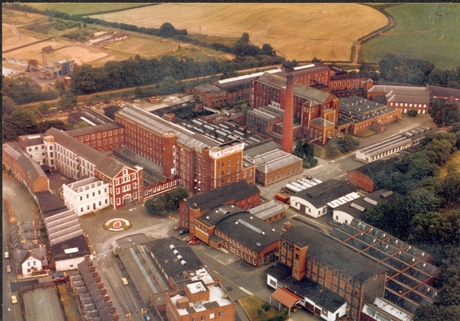
When we were young my father worked for the Linen Thread Company in Hilden, near Lisburn, and flax was still being spun there.  We used to play with the wooden bobbins and used the combing needles, or hackle pins, to start a screw hole, etc.  The whole industry changed over to making synthetic thread – nylon, etc. – contributing to the decline of the linen industry.  I worked there myself one summer, I had a contract to replace windows on the third floor of one of the mill buildings, while the German machinery – and the music-while-you-work – rattled loudly in my ears.  It was impossible to have a conversation.

Linen mills are found all over Belfast, Lisburn and many other towns in Northern Ireland, though few of them produce linen today.  The pale blue flowers of the flax plant are becoming a thing of the past, too.

Thursday, 31 May 2012

Celtic Roots Craic! 52 – 'On the wings of an eagle'

Eagle Wing at sea
Last show I talked a bit about Belfast's new Titanic Quarter and the Titanic Belfast centre.  Last Saturday we had a bit of a wander down there in the sun and checked out the facilities on offer.  There's no free parking and you have to be prepared to do a bit of walking to get anywhere.

The SS Nomadic – sister ship to Titanic, Britannic and Olympic, and the only ship remaining of the White Star Line – is currently in the dry dock at Abercorn Basin being re-furbished.  Nomadic was used to carry 1st and 2nd class passengers from Cherbourg out to the Titanic and Olympic.

At the moment there is also a small Belfast Harbour Marina, with temporary facilities, in Abercorn Basin at the back of the Odyssey building.  Eventually, as the Titanic Quarter is developed this marina will move to the dock below the famous Harland and Wolff cranes, Goliath and Samson.

The Titanic wasn't the only ship to leave Ireland for the USA and not to arrive.  In fact, the very first ship to leave here for America was the Eagle Wing, which set off as early as 1636!  The ship was named from verses in Exodus and Isaiah, referring to the children of Israel being "carried on eagles' wings" and "soaring on wings like eagles".  This ship was built at Groomsport Harbour, on the southern shore of Belfast Lough, from 1631 on.  In 1636, 140 Presbyterian men, women and children – including four ministers – set sail for the New World in order to escape the limitations on their religious freedom, being imposed upon them by the Church of England and the English government.

Although the province of Ulster had been planted largely with Scots Presbyterians in the early 1600s, the province had subsequently been divided up into Anglican parishes, with some Presbyterian and Puritan ministers being allowed to minister in a few parishes.  Four Scots Presbyterian ministers – Blair, Welch, Livingston, and Dunbar – twice excluded from ministering in their churches, began to make plans to travel to the New World.  They made contact with Cotton Mather in New England and were assured that they would be free to practise their own unique form of Christianity there.  They sent over an agent who selected a tract of land near the mouth of the Merrimack River, on the border between Massachussetts and New Hampshire,

Groomsport Harbour and village, Co. Down
The 150 ton ship set sail from Lockfergus (present day Carrickfergus) on the north shore of Belfast Lough – with Blair, Livingston and two other preachers, Hamilton and McClelland, aboard.  They immediately had some trouble with unfavourable winds off the coast of Scotland, and grounded the ship to look for leaks in the keel.  Setting off again, they managed to cover more than half of the journey, but then encountered very stormy seas, high winds and heavy rain, resulting in a broken rudder – mended by the captain, Andrew Agnew – torn sails and other serious damage to the ship, which also sprung a leak.  Even when several passengers became sick and two died – a child and an old person – they remained 'cheerful and confident'.  One child was born during the journey and was baptised by Mr. Livingston, who named it, Seaborn.

The captain and crew told the ship's company that it was impossible to hold out any longer, with more storms to be expected before they could reach their goal.  Eventually, after much prayer and discussion, the passengers agreed to give in to their urging.  The Eagle Wing turned back for Ireland and entered the harbour at Lockfergus again on 3rd of November, after an absence of about eight weeks.

The company of the Eagle Wing, having sold all their possessions to buy goods to trade in America, and with people they had hired to help them to fish and to build houses there demanding their wages, were a good deal worse off than before they set sail.  The four ministers, still not accepted in Ireland by the ruling authorities, returned to Scotland the following year, where they had more success.  They were welcomed by the people there and became instrumental in the subsequent overturn of the episcopal form in Scotland, which has been largely Presbyterian ever since.

Eventually, more settlers from Ulster did make it to Boston and Portland in 1718, the passengers immediately inquiring about the piece of land on the Merrimack River – very likely Londonderry, New Hampshire – where they then settled.  More and more ships brought Ulster Scots settlers to America, in turn becoming pioneers and frontiersmen.  As they established each new settlement, they would first build a fort for protection from the natives and then they would build a church and a school. 

The Rev. Francis Makemie came from Ulster to America in 1683 and organised the first Presbyterian Church in America, becoming the "Father of American Presbyterianism", and in the years that followed, Ulstermen played a tremendous part in the spread of Presbyterianism in America.  Ulster Scots settlers founded schools all over the country. One of the most notable being William Tennent's Log College, founded at Neshaminy in Pennsylvania, which became the forerunner of Princeton University.

They were also involved in politics and were instrumental in the Declaration of Independence, at least eight of the signatories being of Ulster Scots background.  The document was originally handwritten by Charles Thompson, from Maghera, Co. Londonderry, and it was printed by John Dunlap, an Ulster Scot from Strabane.  At least fourteen US presidents have had Ulster Scots origins, with several others having maternal links.  From 1881-1904 the US had a continuous 23 year run of Ulster Scots presidents!  Hopefully, we've made a positive contribution, rather than otherwise!

Tuesday, 10 April 2012

Celtic Roots Craic! 51 – Goliath, Samson and 'Titanic Belfast'

Titanic Belfast

10th April, 2012

A new phenomenon in Belfast in recent years has been the development of 'quarters.'  First we had what is now known as the Cathedral Quarter which, strangely enough, is near St. Anne's Cathedral to the north of the city centre.  Like Dublin's Temple Bar area, this is an area of narrow cobbled streets, restaurants, old pubs and new pubs in old buildings, with music and other entertainment.  Just opposite the cathedral is Writer's Square, with the names of local writers inlaid in the pavement, where music and arts events are held.

On the other side of the city centre, bordering the Lower Ormeau area are a group of streets we've always referred to as the Holy Land – because it includes Jerusalem Street, Palestine Street, Damascus Street, Carmel Street and Cairo Street.  This used to be a mixed residential area of small two and three story terraced houses, but it has changed dramatically over the last few years.  Most of the original inhabitants have gone.  A small number of immigrant families still live there, but the area has been invaded by several thousand students – from both Queen's University and the University of Ulster – as developers have converted and extended the small houses into student housing, leaving only the original facades unchanged.

The area is now officially part of what's known as Queen's Quarter, an area encompassing the buildings of Queen's University, a proposed new site for the University of Ulster, (which is currently outside the city), student accommodation and lots of bars, clubs and nightspots.

White Star Line poster of Titannic
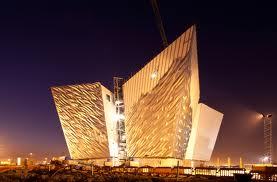
The most recent quarter is in east Belfast and it's been gettin' kinda busy recently – because we're about to celebrate the 100th anniversary of a great tragic event – the sinking of the RMS Titanic.  In the docks area, near the former Harland & Wolff shipyard, we now have a spectacular new building – the Titanic Belfast centre.  The building cost £77M to build and has four wings, each looking like the prow of the ship itself, joined by a central glass tower.  Inside you can learn everything there is to know about the Titanic – how it was built, the shipyard it was built in, fitting out the ship, her maiden voyage, the sinking.  You can even visit and explore the wreck underwater.

The Titanic was built in the Harland & Wolff shipyard in east Belfast – at that time the largest shipyard in the world.  In 1910 Belfast was a boom town, a strong leader in engineering and linen manufacture as well as shipbuilding.  At that time the Titanic was the largest and most luxurious liner in the world.  The shipyard employed over 35,000 people in the early 1900s – including my grandfather!

The yard was founded in 1862 and has the world's largest dry dock and later the two huge yellow cranes, which dominate the Belfast skyline, manufactured by the German company, KruupGoliath (315 ft high) was the first, in 1969, followed by Sampson, in 1974 (348 ft high).  Each crane spans 259 feet, can lift a load of 840 tons, and run on rails, driven by their own huge diesel engines inside the top of the main leg of each crane – two engines in each, one for backup. 

Filming the Titanic Quarter from 300ft up on top of Goliath crane
When the Titanic Quarter was first being planned a few years ago I was asked to film the site for their new website, from the top of the Goliath crane.  We had to get special permission to film from there and were taken up in the tiny lift inside the leg of the crane, to the engine platform at the top.  The lift tends to bounce up and down rather alarmingly as it travels!  At the top is the gantry, which looks like a large red shed, that travels on rails from one side of the crane to the other and houses the lifting gear.  The driver is suspended from this in a little downward projecting cabin, so that he can have all round vision.

Seeing we had a once-in-a-lifetime chance to film from the top of the crane, we took guitars up with us and filmed each other performing on top of Goliath.  At first it was beautiful sunny spring weather and I got some great footage of ships moving and a plane landing at the nearby George Best City Airport

Unfortunately, when I was being filmed performing, not only did my guitar strap come adrift, but a sudden wintry squall came in around us, with strong winds and snow hitting us horizontally.  We had to grab camera, tripod and guitars and scramble quickly for safety down the stairs to the engine platform at the top of the leg of the crane!

In 2007 the Goliath crane crashed into one of the smaller cranes – at 95 tonnes! – knocking it over in what could have been a lethal accident.  (Check it out on YouTube under Harland & Wolff Crane Accident).

The Titanic was built in this dock, although smaller cranes were used in her construction, along with sister White Star Line ships, Olympic and Britannic; the Royal Navy cruiser, HMS Belfast; P&O's SS Canberra and dozens of other ships. Nowadays the yard deals more with refurbishing oil rigs and drilling ships and building wind farm components. 

Titannic left Belfast on the evening of 2nd April, 1912; calling at Southampton in England; Cherbourg, France; and finally Cobh, near Cork City, in the Republic of Ireland; before setting off across the Atlantic for Manhattan, New York City.  She struck an iceberg at almost full speed on April 14th and sank two hours and forty minutes later, with the loss of more than 1,500 lives.

My great uncle, George Given, was booked to travel on the Titannic, but he was so eager to get to Canada that he travelled on an earlier ship instead.  What a providential move that turned out to be, eh?

Saturday, 17 March 2012

Celtic Roots Craic! 50 – 'How's she cuttin' now, byes?'

Celtic brooch sculpture, outside St. Patrick's Centre, Downpatrick
16th March, 2012

Well, it's the time of year for a wee bit a' celebratin' of all things Irish.  I've had a very busy week, so I'm just getting to record this show at the last minute.  We've covered a fair bit of history and culture in the last couple of shows, so maybe I should vary the theme a bit the day?  It often occurs to me how incomprehensible our way of talkin' must sound to most outsiders.  Maybe if you have some Irish background then at least some phrases might be familiar to you?

For instance, a week ago a friend mentioned having had some Swedish people over visiting, when his wife came out with, "Throw yer eye along that there and see if it's straight!"  Apparently, the Swedes looked at one another with no idea of what she was saying.  To be honest, I find it fairly amazing that strangers can understand us at all!  It's not as if we're being deliberately difficult – in fact, most Irishmen probably have a built in need to communicate, to want you to understand them.  Though we'll be likely to phrase it, "Do yez undtherstann' me now, like?" – which probably doesn' help!

Take "Wud ye howl yer whissht?" for example, literally meaning 'hold your breath', or "Would you be quiet?"  Now ye could possibly have known that one from the song, 'There was an aul' woman from Wexford Town'.  If yer behavin' like a bit of an eedjit, now, someone might tell ye to, "Have a wee titther a' wit, now!"  And if that doesn't do it, ye might be towl' to "Catch yerself on!"   If somebody asks ye, "How's she cuttin' now, byes?"  wud ye undtherstann' them?  Mebbe ye would if they said, "How are yez doin' there, lads?"

The answers could possibly be a mite hard to grasp, too: "Ach, I'm bravely, like."  Or, "I'm doin' rightly, so I am."  More than likely we'd answer, "Ach, I'm dead on, ye know?"  If ye were referring to someone who'd recently been ill ye might be heard to say, "Ach, 'e's powerful failed, altogether, so he is."  If ye were talkin' about yerself and ye'd been badly, ye might say, "I'm as w'ake as watther, so I am," "I'm not worth tuppence at the moment,"  Or, "I'm not worth three ha'pence," – which is even worse, obviously!  If ye were short of a bob or two – especially if somebody's askin ye to sub them (to lend them a poun' or two) – ye might say, "Listen, I haven't three ha'pence meself to rub together, so I haven'."

A great deal of our time is spent in "havin' a wee bit a' craic."  It's a way a' "puttin' yer day in," isn't it?  If ye're later home than expected from the pub, or some other event, ye can always report, "Ach, sure the craic was grann'"  or even, "The craic was ninety, so it wuz."  If it was crowded ye would say, "Thon place was hivin' the night."  Or, "It was packed to the gills."  If yer "Rarin' ta go" it means ye're anxious to be off somewhere.  And if a woman is dressed up to go out for the night she might be "all dolled up to the nines." 

On the other hand, someone who never makes any effort to tidy themselves up could be described as, "As througho'rr as they come," or "As rough as purty oaten," – which is actually a mixture of potatoes and oatmeal.  If he's rude as well, he might be described as "an ignorant  sort of a ganch."   An' if he's mean with his money, "He wouldn' give ye daylight, so he wouldn't!"  Or, "That fella wouldn' give ye the time a' day."  If someone is a bit greedy, or an awkward person to deal with, ye might say, "I'd rather have that body a week, as a fortnight!"  If he's a big fella, ye could say, "If he was chocolate, he'd be some 'atin'!" 

Many years ago I spent a few weeks doing some building work on a friend's farm near Belfast.  Every day his mother would feed ye up to the gills with spuds an' stuff at lunchtime.  Then when you went back to work the dad would come over to see how ye were gettin' on and he'd say the same thing every time, "You know, a full sack doesn't bend!" 

If you are listening to a conversation that ye know is in the Irish language, which you don't understand, you could always say, "Ni higim.""I don't understand."   If it's in English, but ye genuinely can't follow what they're sayin', ye could say, "I have no idea what yer bletherin' on about."  If you want to be a little bit more forceful – not to mention, risky! – you could say, "Are you talkin' ta me, or chewin' a brick?"   Not that I recommend that one, ye undtherstand!